
There are very few entertainers whose image is so deeply embedded in popular culture that a silhouette, a hairstyle, a facial expression or a single vocal inflection can identify them instantly.
Michael Jackson is one of them.
Nearly two decades after the King of Pop’s death, Jackson remains more than a recording artist. To millions of fans, he occupies a space somewhere between superstar, cultural landmark and almost sacred musical institution.
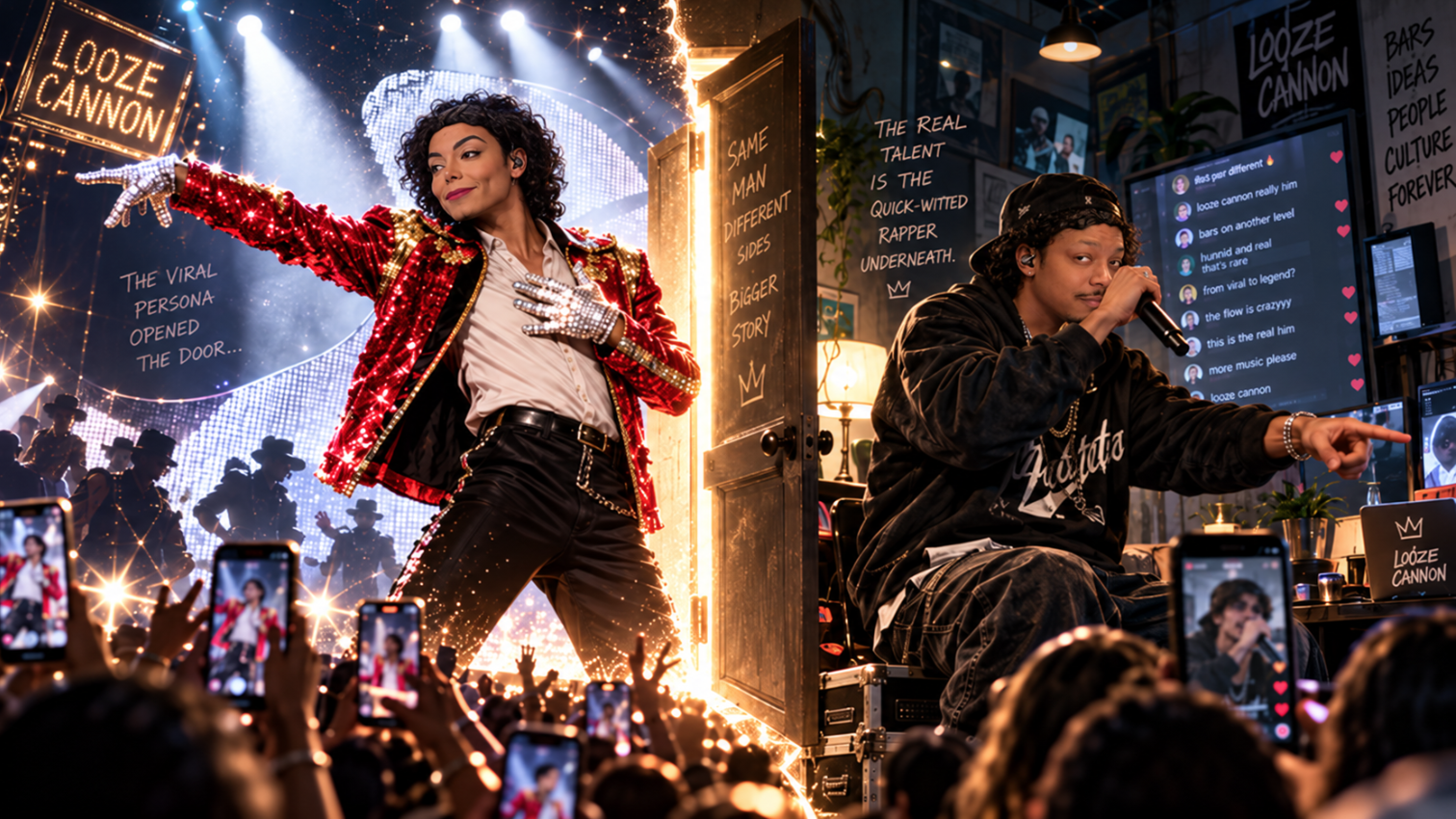
That is what makes the sudden rise of Detroit entertainer Looze Cannon so fascinating—and, depending on your perspective, slightly uncomfortable.
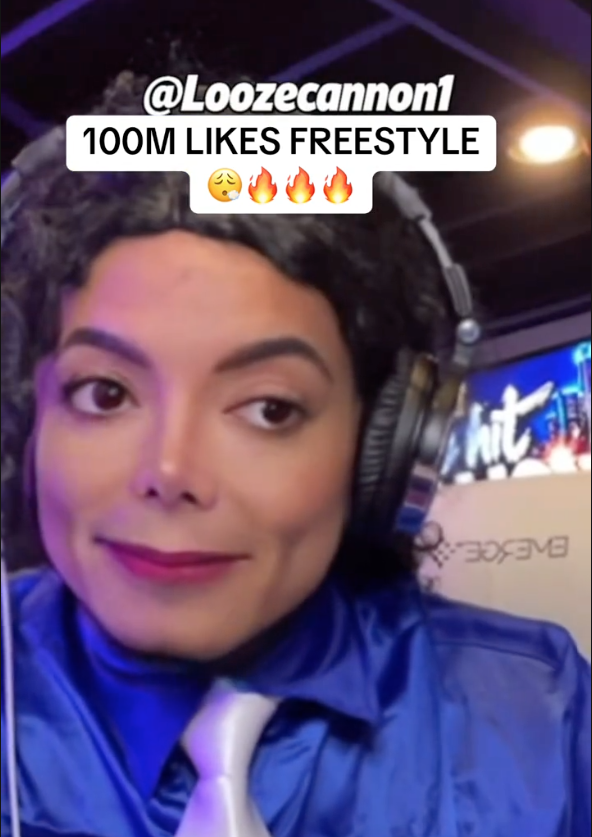
Cannon has exploded across TikTok by appearing in a digital Michael Jackson persona and doing something Jackson himself was never known for doing:
freestyle rapping.
Not merely rapping prewritten punchlines.
Freestyling.
Bantering with people in real time.
Trading jokes.
Reacting instantly.
Changing voices.
Playing characters.
Turning livestream battles into comedy sketches.
And doing much of it while presenting viewers with a face and mannerisms unmistakably associated with one of the most famous human beings who ever stepped onto a stage.
The formula sounds ridiculous on paper.
On TikTok, it has become enormous.
Complex reported on October 24 that Cannon had reached one million TikTok followers and celebrated the milestone with a livestream in which he essentially battled himself—switching between his normal Looze Cannon personality and his exaggerated Michael Jackson character while approximately 70,000 viewers watched.
That raises a question Amplifier has been wrestling with while watching his extraordinary rise:
Are we watching a clever artist use Michael Jackson as a doorway to finally receive the attention his own talent deserves—or are we becoming too comfortable with people monetizing the image of a deceased icon who cannot approve the joke?
The answer may be both.
First, Give the Man His Credit
It would be easy to dismiss Looze Cannon as another social-media impersonator who stumbled into a gimmick.
That would also be inaccurate.
The man behind the character is Glen Cannon, a Detroit musician, rapper, producer, DJ and comedian who has reportedly performed under the Looze Cannon name since at least 2010. He previously performed with Detroit group R2G, worked as a tour guide at the Motown Museum and had an earlier run of viral attention on BIGO Live using the name “Bigo Jackson.”
In other words, TikTok did not manufacture a performer out of nowhere.
It discovered one.
That distinction becomes obvious when Cannon starts freestyling.
The Michael Jackson appearance may make someone stop scrolling, but it does not explain why viewers remain through long livestream sessions.
Cannon is quick.
His timing is good.
He understands crowd interaction.
He knows when to abandon a rhyme and turn it into a joke.
He can respond to another creator without appearing to search desperately for the next line.
Most importantly, he appears to understand something that many livestream personalities never figure out:
A livestream is supposed to be a show.
That may sound obvious.
It apparently is not.
Much of livestream culture revolves around personalities asking for gifts, arguing with other personalities, manufacturing conflict or simply remaining online for extraordinary amounts of time hoping viewers eventually contribute money.
Cannon arrives with a character.
He performs.
He improvises.
He leaves people with lines they repeat after the stream ends.
That is entertainment.
Then Came “I Need M-O-N-E-Y”
Every viral entertainer eventually gets a line.
Cannon found his.
During one of his Michael-flavored freestyles, he began working through the alphabet before landing on the money punchline that spread across social media.
The phrase became a meme, a sound, a lip-sync vehicle and eventually part of Cannon’s first major viral single, “Big Michael Micheal.”
Complex reported that he initially offered the record as a $1.99 direct download, with plans to move it onto broader streaming platforms after reaching a sales goal.
That may be the smartest part of the entire story.
Cannon did not wait for a record label to tell him he had a hit.
He did not wait six months while managers built a campaign.
He watched the audience tell him which phrase mattered, then attempted to convert that attention into direct revenue.
That is the modern creator economy in one decision.
Attention first.
Product second.
Monetization immediately.
The old music-business path was often:
record → label → radio → audience.
The Looze Cannon path is closer to:
character → livestream → meme → audience → record.
That reversal matters.
But Then We Get to Michael
And this is where the story becomes complicated.
Michael Jackson is not a generic character.
He is not Frankenstein.
He is not Dracula.
He is not some fictional pop star invented for comedy.
Michael Jackson was a real person whose face, voice, movements, clothing and personality became globally recognizable intellectual and cultural property.
For devoted Jackson fans, watching someone transform that image into a punchline can feel almost sacrilegious.
Amplifier understands that reaction.
There is something strange about watching someone effectively borrow the face of a dead superstar, attract enormous audiences because of that resemblance and then generate money from the attention.
The closer the impersonation gets, the more uncomfortable the question becomes.
Would the audience be there in comparable numbers if the Michael Jackson face disappeared?
If not, how much of the resulting commercial value belongs to Looze Cannon’s talent—and how much originates from decades of work performed by Michael Jackson?
There is no simple moral answer.
Impersonation Has Always Been Part of Entertainment
We also have to be fair.
Michael Jackson impersonators did not begin with TikTok.
They have performed in Las Vegas.
They have appeared at birthday parties.
They have danced on television.
They have worked tribute shows around the world.
Elvis Presley created an entire impersonator economy.
Marilyn Monroe, Prince, James Brown and other iconic performers have all inspired tribute acts.
Comedy itself frequently depends on imitation.
The difference today is scale and technology.
A tribute performer once had to buy a costume, practice choreography and convince a club to book the show.
A digital creator can now potentially place an iconic face over his own and reach hundreds of thousands of viewers without leaving a room.
That fundamentally changes the economics.
It also changes the legal questions.
Earlier this year, Michael Jackson’s estate and the operator of a Las Vegas tribute act ended litigation involving trademarks, publicity rights and other intellectual-property issues surrounding Jackson’s identity. Bloomberg Law described the dispute as involving a complicated collection of rights attached to the late superstar.
California publicity law also recognizes protectable interests in celebrity identity, while courts have had to balance those interests against expressive and transformative uses.
Amplifier is not suggesting that Looze Cannon has violated those rights. We do not know what permissions, legal advice, platform arrangements or defenses may apply to his specific performances.
But anyone making serious money from an instantly recognizable deceased celebrity persona eventually enters territory where parody, transformation, tribute, trademark and right-of-publicity questions become more than academic.
There Is Another Twist: Cannon Says It Is Not AI
Several people online have described Cannon’s Michael Jackson appearance as an AI filter.
Cannon has disputed that characterization.
Complex reported that after another impersonator accused him of relying on AI face and voice technology, Cannon responded that he was not using AI and insisted the performance was him.
That distinction deserves to be explored directly with Cannon.
What technology is actually being used?
How much of the facial transformation is digital?
How much of the voice is performance?
What does he consider parody?
Has he communicated with anyone connected to Jackson’s estate?
Where does he personally draw the line between tribute and exploitation?
Those are exactly the kinds of questions that become more interesting as the audience grows.
And Amplifier is currently working to secure an exclusive conversation with Looze Cannon so that he can answer them himself.
The Character Should Not Obscure the Rapper
This is the part of the conversation we believe deserves more attention.
Take away the Michael face for a moment.
Listen to the timing.
Cannon can rap.
That is not an insignificant detail.
Viral characters frequently collapse when creators attempt to move outside the gimmick that made them famous.
The joke works.
The song does not.
The meme works.
The person underneath it has nothing else to offer.
Looze Cannon appears to have the opposite problem.
The gimmick may be so strong that people are overlooking the actual artist.
His freestyle sessions demonstrate quick thinking that cannot easily be manufactured by a face effect.
A filter cannot rescue bad timing.
A filter cannot invent personality.
A filter cannot read another person’s energy during a live interaction.
A filter cannot make a weak rapper suddenly become good at improvisation.
That belongs to Cannon.
And that may ultimately determine whether he becomes a moment or builds a career.
One Million Followers Changes the Stakes
Reaching a million followers means the conversation is no longer about a funny clip that happened to go viral.
Cannon now has an audience.
Complex reported that his million-follower celebration included a livestream watched by roughly 70,000 people.
Another firsthand account of his recent TikTok activity described streams peaking above 90,000 simultaneous viewers and accumulating enormous engagement, although those figures come from an individual observer rather than independently audited platform data.
Even using the more conservative reported figures, the trajectory is extraordinary.
Celebrities are noticing.
Musicians are appearing in his orbit.
The character is escaping TikTok and moving into broader entertainment coverage.
And Cannon has begun doing interviews in which audiences are being introduced to the person underneath the digital persona.
That transition is critical.
Because there is a limited amount of time in every viral cycle when the creator gets to answer a fundamental question:
What happens when the joke stops being new?
“Big Michael” Cannot Be the Whole Business
If Cannon wants longevity, the next chapter probably has to introduce more Glen Cannon and slightly less Michael.
Not because the Michael character should disappear.
It is clearly an effective comedy vehicle.
But successful entertainers eventually convert attention borrowed from a concept into loyalty directed toward themselves.
Eddie Murphy could impersonate James Brown, but audiences ultimately came to see Eddie Murphy.
Jamie Foxx could imitate other entertainers, but the impressions became one part of a much larger talent package.
Wayans-family comedy frequently depended on parody, but the performers developed identities independent of the people being parodied.
That is the opportunity Cannon now has.
The Michael character got everyone's attention.
The freestyle rapper can keep it.
Amplifier Is Still Torn
We will admit it.
There is a part of this that makes us uncomfortable.
Michael Jackson gave the world an image so distinct that it remains commercially valuable seventeen years after his death.
He cannot approve this.
He cannot laugh at it.
He cannot object to it.
And his family and estate continue to manage a legacy that is simultaneously artistic, emotional and enormously valuable.
There is something worth protecting there.
At the same time, Michael Jackson’s influence was so enormous that completely separating popular entertainment from his image may be impossible.
His dance moves became language.
His vocal mannerisms became language.
His fashion became language.
His videos became templates.
His influence belongs to history even while particular legal rights remain controlled.
That is what genuine cultural immortality looks like.
People quote you.
People imitate you.
People parody you.
People argue about you.
People build new art out of the vocabulary you left behind.
Looze Cannon is operating directly inside that contradiction.
Maybe That Is Why It Works
The joke works because everybody knows who Michael Jackson is.
The freestyle works because Looze Cannon knows who he is.
Those two things collided at exactly the right moment.
The internet saw the King of Pop’s face.
Then it heard a Detroit rapper with a strange sense of humor start firing off bars.
And instead of scrolling away, people stayed.
That is the part no filter can guarantee.
Virality can introduce a performer.
It cannot force an audience to return.
Looze Cannon appears to have figured out how to make them return.
Now comes the harder challenge:
Can he turn “Big Michael” into an introduction to Glen Cannon rather than allow Glen Cannon to disappear permanently behind Michael Jackson?
That may determine whether we are watching another internet phenomenon—or the bizarre beginning of a genuinely significant entertainment career.
Amplifier intends to ask him.
Amplifier Exclusive Watch: Amplifier Music Magazine is working to secure an exclusive interview with Looze Cannon. Among the subjects we want to discuss are his freestyle background, the technology behind the Michael Jackson presentation, his feelings about profiting from an iconic likeness, his Detroit roots, “Big Michael Micheal,” his sudden audience growth and what he wants people to know about the artist behind the character.
Editorial Note: Some online commentary describes Looze Cannon’s Michael Jackson presentation as an AI filter. Cannon has publicly denied using AI for the character. Until Amplifier speaks with him directly or independently verifies the technology, we are describing it as a digital Michael Jackson persona/effect rather than presenting either claim as established fact.